AQA GCSE English Language 8700
Paper 1: The station
8700/1: Explorations in creative reading and writing
- Specification
- 3.1.1 Reading; 3.1.2 Writing; AO1, AO2, AO4, AO5, AO6
- Marks
- 80
- Suggested time
- 105 minutes
Lena visits the disused station where her father worked. Answer Questions 1–4 on the source; Question 5 is your own writing. Suggested timings: read 10 minutes; Q1 5; Q2 10; Q3 10; Q4 25; Q5 45.
The station
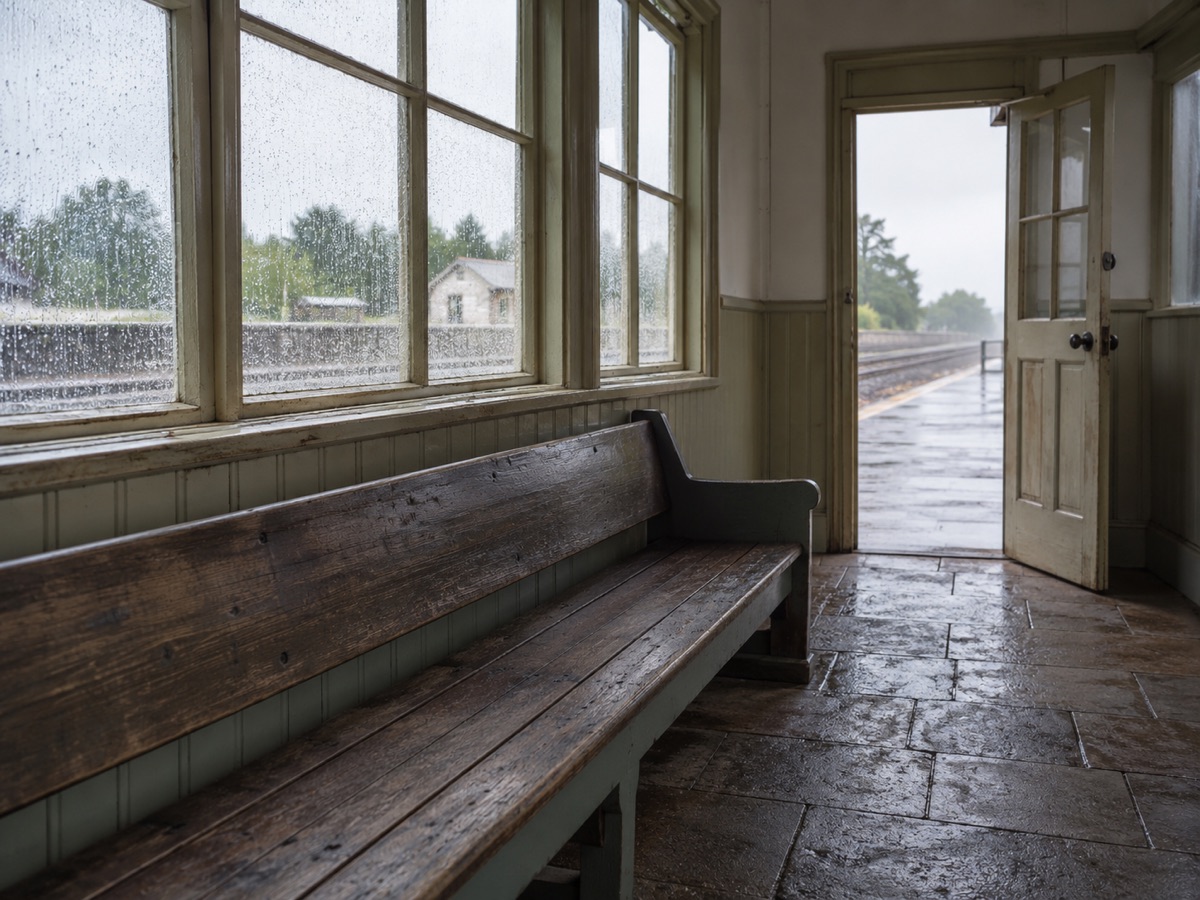
- At six o’clock, Lena let herself into the closed station with her father’s old key.
- The last passenger train had left this village twelve years earlier.
- Tonight the council would decide whether to turn the building into a café.
- She had promised to photograph the waiting room before the meeting.
- Outside, the rain tapped on the boards covering the ticket window.
- She placed her bag on a bench and took out her camera.
- Her father had worked here; she had never seen him at his post.
- The room smelled of damp wood and the cold dust of a place left sleeping.
- A row of hooks reached from the wall like small, empty hands.
- Under the cracked clock, a timetable curled away from its frame.
- The light from Lena’s torch crept across it, searching each faded column.
- Names of towns she knew became ghostly destinations in the narrow beam.
- Nothing moved except a drop of water gathering on the ceiling.
- It swelled slowly, holding a tiny white reflection of the torch.
- Then it fell onto the bench with a sound much louder than it should have made.
- Lena lowered the camera. For a moment she held her breath and listened.
- The room seemed to hold its breath with her, every dark corner waiting.
- A scrape came from beyond the locked door to the platform.
- She told herself it was a loose shutter catching the wind.
- But the sound came again, closer, and was followed by three careful taps.
- Lena’s hand shook as she fitted the key into the platform door.
- The lock resisted. She tried again, turning it slowly so the key would not break.
- On the other side someone said her name, softly, as if asking a question.
- She recognised the voice, although she had not heard it for months.
- ‘Mr Vale?’ The name sounded too loud in the waiting room.
- Her father’s former colleague stood beneath the broken platform roof.
- Water ran from the brim of his hat. He was carrying a flat parcel.
- ‘Your dad asked me to keep this,’ he said. ‘I should have brought it sooner.’
- Lena opened the door fully, but neither of them stepped through it.
- She had always thought the station was a story that belonged to other people.
- Mr Vale held out the parcel, and she saw the edge of a familiar handwriting.
- For a while she looked at it without reaching forward.
- Behind him, the abandoned rails shone where the rain had washed them clean.
- At last she took the parcel. It was lighter than she had expected.
- ‘Come inside,’ she said, moving her bag to make room on the bench.
- She left the camera where it was and switched on the second torch.
1 Use lines 1–6. Select one answer in each part. (a) When does Lena enter? A six o’clock / B noon / C midnight. (b) When did the last train leave? A twelve days earlier / B twelve months earlier / C twelve years earlier. (c) What might the station become? A a café / B a school / C a shop. (d) Why has Lena come? A to catch a train / B to photograph the waiting room / C to buy a ticket.
4 marks
2 Using lines 8–17, analyse how the writer uses language to make the waiting room seem unsettling. Support your ideas with evidence.
8 marks
3 How does the writer structure the whole source to create tension? Explain changes of focus and their effects, using evidence.
8 marks
4 Focus on lines 20–36. ‘Lena becomes more confident when she discovers who is outside.’ To what extent do you agree and/or disagree? Evaluate the writer’s methods and support your judgement with evidence from these lines.
20 marks
5 Write the opening of a story in which an unexpected visitor changes someone’s plans. Establish a setting and character, and shape the opening to interest your reader. Your writing will be assessed for content and organisation (24 marks) and technical accuracy (16 marks).
40 marks